2019
Center for Reproductive Rights Annual Report, 2019
Art Direction, Brand, Editorial Design, Data Visualization, Print, Project Management, Visual Identity
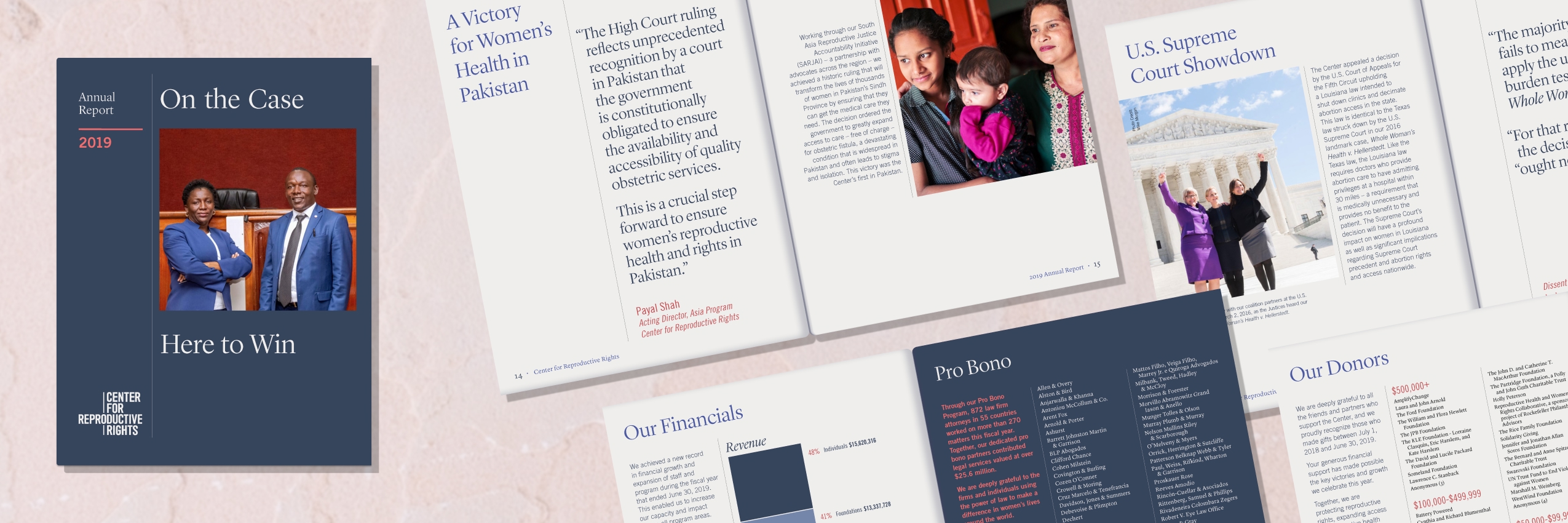
In 2019, I led art direction, layout design, and print production for the Center for Reproductive Rights’ Annual Report, collaborating closely with long‑trusted printer Rosemont Press. This was the first annual report where I held full creative leadership, working alongside Project Manager Elizabeth Lucy and Digital Designer Gabriel Lee. I partnered with executives and stakeholders across the organization to present concepts, refine content, and ensure accuracy. The design direction drew from layouts developed for the Center’s forthcoming rebrand by Isometric Studio, giving donors an early glimpse of the new identity ahead of its official launch.
Made with Adobe InDesign CC and Adobe Photoshop CC
The Process
Balancing tradition with a forthcoming rebrand, I guided the report through shifting expectations without losing clarity or pace.
The project kicked off with a meeting between Elizabeth Lucy, the Chief Executive of Fundraising, and myself, where a verbal brief outlined essential content and past workflows. From there, I maintained continuous communication with Elizabeth through face‑to‑face check‑ins and Skype, while coordinating with content experts in person and via email for global offices. Reviews for executives were printed and presented in person, ensuring clarity and alignment.
Early in the process, I tested assumptions about how far the design should lean toward the new brand by presenting three concept directions: one in the old brand, one in a balanced middle ground, and one pushing into the new identity. Contrary to my expectation that executives might prefer the safer option, they embraced the forward‑looking approach, and I refined the chosen direction to lean further into the new brand without fully revealing it.
Decision‑making followed a strict hierarchy: content and design were first reviewed by Communications staff, then by divisional leaders, before moving to executives. The CEO retained final approval. I presented broad concepts early to the CEO, followed by structured review rounds with the fundraising executive. Feedback was exchanged primarily through verbal discussions and print markups, with additional transparency maintained via email updates and Asana‑documented workflows. I also provided feedback to writers directly, either in person or by email, to ensure edits were clear and aligned with layout needs.
Timeliness and quality were the key measures of success. By securing early buy‑in and maintaining executive involvement throughout, I avoided late‑stage disruptions and delivered the report to print a full week ahead of schedule. This allowed ample time for proofing and ensured flawless print quality.
The Outcome
The final report was printed with a paired envelope and mailed to donors—including a newly expanded list of high‑profile supporters—by mid‑December, ahead of schedule. It contributed to year‑end fundraising efforts and provided a polished preview of the forthcoming brand identity. Beyond strengthening the organization’s credibility during a pivotal moment, the project also elevated my standing with executive leadership, positioning me as a trusted champion of the brand.


Related Projects